"Nadal" redirects here. For other people, see Nadal (surname).
This name uses Spanish naming customs: the first or paternal family name is Nadal and the second or maternal family name is Parera.
Rafael Nadal

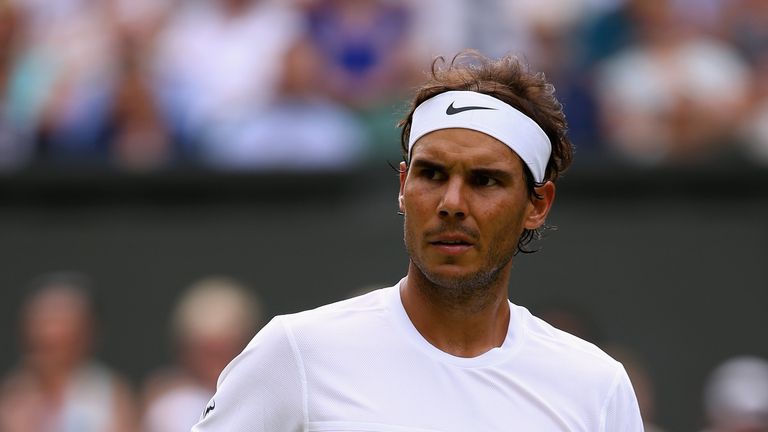
Nadal at the 2015 Australian Open
|
| Full name | Rafael Nadal Perrera |
|---|
| Country |  Spain Spain |
|---|
| Residence | Manacor, Balearic Islands, Spain |
|---|
| Born | 3 June 1986 (age 29)
Manacor, Balearic Islands, Spain |
|---|
| Height | 1.85 m (6 ft 1 in) |
|---|
| Turned pro | 2001 |
|---|
| Plays | Left-handed (two-handed backhand) |
|---|
| Coach(es) | Toni Nadal (1990–) |
|---|
| Prize money | $72,745,277 |
|---|
| Official website | rafaelnadal.com |
|---|
| Singles |
|---|
| Career record | 739–150 (83.13% in ATP World Tour, Grand Slam main draw matches and Davis Cup) |
|---|
| Career titles | 66 (ranked 5th in the Open Era) |
|---|
| Highest ranking | No. 1 (18 August 2008) |
|---|
| Current ranking | No. 10 (8 June 2015)[1] |
|---|
| Grand Slam Singles results |
|---|
| Australian Open | W (2009) |
|---|
| French Open | W (2005, 2006, 2007, 2008,2010, 2011, 2012, 2013,2014) |
|---|
| Wimbledon | W (2008, 2010) |
|---|
| US Open | W (2010, 2013) |
|---|
| Other tournaments |
|---|
| Tour Finals | F (2010, 2013) |
|---|
| Olympic Games |  Gold medal (2008) Gold medal (2008) |
|---|
| Doubles |
|---|
| Career record | 112–64 |
|---|
| Career titles | 9 |
|---|
| Highest ranking | No. 26 (8 August 2005) |
|---|
| Current ranking | No. 158 (25 May 2015)[2] |
|---|
| Grand Slam Doubles results |
|---|
| Australian Open | 3R (2004, 2005) |
|---|
| Wimbledon | 2R (2005) |
|---|
| US Open | SF (2004) |
|---|
| Team competitions |
|---|
| Davis Cup | W (2004, 2008, 2009, 2011) |
|---|
| Last updated on: 5 June 2015. |
| Olympic medal record |
|---|
| Competitor for Spain |
|---|
| Men's Tennis |
|---|
 | 2008 Beijing | Singles |
Rafael "Rafa" Nadal Parera (Catalan: [rəfəˈɛɫ nəˈðaɫ pəˈɾeɾə], Spanish: [rafaˈel naˈðal paˈɾeɾa]; born 3 June 1986) is a Spanish professional tennis player currently ranked world No. 10.[3] He is widely regarded as the greatest clay court player in history[a] and has been titled "The King of Clay."[b] His evolution into an all-court threat has established him as one of the greatest players in tennis history,[c] with some considering Nadal to be the greatest player of all time.[23][24][25][26]
Nadal has won 14 Grand Slam singles titles, the 2008 Olympic gold medal in singles, a record 27 titles ATP World Tour Masters 1000[27][28][29] and 15 ATP World Tour 500 tournaments. He was also a member of the winning Spain Davis Cup team in 2004,2008, 2009, and 2011. In 2010, he became the seventh player in history and youngest of four in the Open Era to achieve theCareer Grand Slam. He is the second male player, after Andre Agassi, to complete the singles Career Golden Slam. In 2011, Nadal was named the Laureus World Sportsman of the Year.[30]
Nadal and Mats Wilander are the only two male players in history who have won at least two Grand Slam titles on three different surfaces—hard court, grass, and clay.[31] By winning the 2014 French Open, Nadal became the only male player to win a single Grand Slam tournament nine times and the first to win at least one Grand Slam tournament for ten consecutive years, breaking the record of eight consecutive years previously shared by Björn Borg, Pete Sampras, and Roger Federer. Nadal holds the record formost consecutive titles at a particular tournament after winning his eighth straight Monte-Carlo Masters in 2012. He has won at least one Masters 1000 and one ATP 500 series tournament for 10 consecutive years.
Contents
[hide]
- 1 Early life
- 2 Tennis career
- 2.1 2002–2004
- 2.2 2005: First Grand Slam title
- 2.3 2006: Second French Open title
- 2.4 2007: Third French Open title
- 2.5 2008: French Open, Wimbledon, Olympic Gold & ascent to No. 1
- 2.6 2009: Australian Open title, loss at French Open
- 2.7 2010: Return to No. 1 and Career Grand Slam
- 2.8 2011: Sixth French Open title
- 2.9 2012: Seventh French Open title
- 2.10 2013: Eighth French Open, second US Open title and return to No. 1
- 2.11 2014: Ninth French Open title and struggle with injury
- 2.12 2015: Continued struggle with form and fall in rankings
- 3 Rivalries
- 3.1 Nadal vs. Federer
- 3.2 Nadal vs. Djokovic
- 3.3 Nadal vs. Murray
- 4 Playing style
- 5 Public image
- 5.1 Equipment and endorsements
- 5.2 In popular culture
- 5.3 Asteroid
- 6 Off the court
- 6.1 Involvement in football
- 6.2 Philanthropy
- 6.2.1 Fundación Rafa Nadal
- 6.3 Personal life
- 7 Career statistics
- 7.1 Grand Slam tournament performance timeline
- 7.2 Year-end Championship performance timeline
- 7.3 Olympic Games
- 7.4 Records
- 7.4.1 All-time tournament records
- 7.4.2 Open Era records
- 8 See also
- 9 Notes
- 10 References
- 11 External links
Early life
Rafael Nadal was born in Manacor, Balearic Islands, Spain, to Sebastián Nadal, a businessman who owns an insurance company, a glass and window company, Vidres Mallorca, and manages his own restaurant, Sa Punta. His mother is Ana María Parera, a housewife. He has a younger sister named María Isabel. His uncle, Miguel Ángel Nadal, is a retired professional footballer, who played for RCD Mallorca, FC Barcelona, and the Spanish national team.[32] Nadal supports football clubs Real Madrid and RCD Mallorca.[33] Recognizing that Nadal had a natural talent for tennis, another uncle, Toni Nadal, a former professional tennis player, introduced him to tennis when he was three years old.[34]
At age eight, Nadal won an under-12 regional tennis championship at a time when he was also a promising football player.[35] This made Toni Nadal intensify training, and at that time he encouraged Nadal to play left-handed for a natural advantage on the tennis court, as he noticed Nadal played forehand shots with two hands.[35] This may be due to the fact he is ambidextrous, playing tennis with his left hand, and writing with his right.[36]
When Nadal was 12, he won the Spanish and European tennis titles in his age group and was playing tennis and football all the time.[35] Nadal's father made him choose between football and tennis so that his school work would not deteriorate entirely. Nadal said: "I chose tennis. Football had to stop straight away."[35]
When he was 14, the Spanish tennis federation requested that he leave Mallorca and move to Barcelona to continue his tennis training. Nadal's family turned down this request, partly because they feared it would hurt his education,[35] but also because Toni said that "I don't want to believe that you have to go to America, or other places to be a good athlete. You can do it from your home."[34] The decision to stay home meant that Nadal received less financial support from the federation; instead, Nadal's father covered the costs. In May 2001, he defeated former Grand Slam tournament champion Pat Cash in a clay-court exhibition match.[32]
Nadal turned professional at the age of 15,[37] and participated in two events on the ITF junior circuit. In 2002, at the age of 16, Nadal reached the semifinals of the Boy's Singles tournament at Wimbledon, in his first ITF junior event.[38]
By the age of 17, he beat Roger Federer the first time they played and became the youngest man to reach the third round at Wimbledon since Boris Becker. At 18, he helped pace Spain over the US in the junior Davis Cup in his second, and final, appearance on the ITF junior circuit. At 19, Nadal won the French Open the first time he played it, a feat not accomplished in Paris for more than 20 years. He eventually won it the first four times he played at Roland Garros.[37] In 2003, he had won the ATP Newcomer of the YearAward. Early in his career, Nadal became known for his habit of biting the trophies he won.[39]
Tennis career
2002–2004
In April 2002, at 15 years and 10 months, the world No. 762 Nadal won his first ATP match, defeating Ramón Delgado, and became the ninth player in the Open Era to do so before the age of 16.[40] The following year, Nadal won two Challenger titles and finished the year in the top 50. At his Wimbledon debut in 2003, Nadal became the youngest man to reach the third round since Boris Becker in 1984.[41]
Nadal reached the third round of the 2004 Australian Open where he lost in three sets against Australian Lleyton Hewitt. Interestingly, had he won, he would have faced Roger Federer in the next round.[42] Later that year, Nadal played his first match against world No. 1 Roger Federer at the 2004 Miami Masters, and won in straight sets, before losing to Fernando González in the fourth round. He was one of the six players who defeated Federer that year (along with Tim Henman, Albert Costa, Gustavo Kuerten, Dominik Hrbatý, and Tomáš Berdych). He missed most of the clay court season, including the French Open, because of a stress fracture in his left ankle.[32]
Nadal, at 18 years and six months, became the youngest player to register a singles victory in a Davis Cup final for a winning nation.[43] By beating world No. 2 Andy Roddick, he helped Spain clinch the 2004 title over the United States in a 3–2 win. He finished the year ranked world No. 51.
2005: First Grand Slam title
At the 2005 Australian Open, Nadal lost in the fourth round to eventual runner-up Lleyton Hewitt. Two months later, Nadal reached the final of the 2005 Miami Masters, and despite being two points from a straight-sets victory, he was defeated in five sets by world No. 1 Roger Federer. Both performances were considered to be breakthroughs for Nadal.[44][45]
He then dominated the spring clay court season. He won 24 consecutive singles matches, which broke Andre Agassi's Open Era record of consecutive match wins for a male teenager.[46] Nadal won the Torneo Conde de Godó in Barcelona and beat 2004 French Open runner-up Guillermo Coria in the finals of the 2005 Monte Carlo Masters and the2005 Rome Masters. These victories raised his ranking to world No. 5[47] and made him one of the favorites at his career-first French Open. On his 19th birthday, Nadal defeated Federer in the 2005 French Open semifinals, being one of only four players who defeated the top-seeded player that year (along with Marat Safin, Richard Gasquet, and David Nalbandian). Two days later, he defeated Mariano Puerta in the final, becoming the second male player after Mats Wilander to win the French Open on his first attempt. He also became the first teenager to win a Grand Slam singles title since Pete Sampras won the 1990 US Open at age 19.[32] Winning the French Open improved Nadal's ranking to world No. 3.[47]
Three days after his victory in Paris, Nadal's 24-match winning streak was snapped in the first round of the grass court Gerry Weber Open in Halle, Germany, where he lost to the German Alexander Waske.[48] He then lost in the second round of 2005 Wimbledon to Gilles Müller of Luxembourg.
Immediately after Wimbledon, Nadal won 16 consecutive matches and three consecutive tournaments, bringing his ranking to world No. 2 on 25 July 2005.
Nadal started his North American summer hard-court season by defeating Agassi in the final of the 2005 Canada Masters, but lost in the first round of the 2005 Cincinnati Masters. Nadal was seeded second at the 2005 US Open, where he was upset in the third round by world No. 49 James Blake in four sets.
In September, he defeated Coria in the final of the China Open in Beijing and won both of his Davis Cup matches against Italy. In October, he won his fourth ATP Masters Series title of the year, defeating Ivan Ljubičić in the final of the 2005 Madrid Masters. He then suffered a foot injury that prevented him from competing in the year-ending Tennis Masters Cup.[49]
Both Nadal and Federer won eleven singles titles and four ATP Masters Series titles in 2005. Nadal broke Mats Wilander's previous teenage record of nine in 1983.[50] Nine of Nadal's titles were on clay, and the remainder were on hard courts. Nadal won 79 matches, second only to Federer's 81. Nadal won the Golden Bagel Award for 2005, with eleven 6–0 sets during the year.[51] Also, he earned the highest year-end ranking ever by a Spaniard and the ATP Most Improved Player of the Year award.
2006: Second French Open title
Nadal missed the Australian Open because of a foot injury.[52] In February, he lost in the semifinals of the first tournament he played, the Open 13tournament in Marseille, France. Two weeks later, he handed Roger Federer his first loss of the year in the final of the Dubai Duty Free Men's Open (in 2006, Rafael Nadal and Andy Murray were the only two men who defeated Federer). To complete the spring hard-court season, Nadal was upset in the semifinals of the Pacific Life Open in Indian Wells, California, by James Blake, and was upset in the second round of the 2006 Miami Masters.
On European clay, Nadal won all four tournaments he entered and 24 consecutive matches. He defeated Federer in the final of the Masters Series Monte Carlo in four sets. The following week, he defeated Tommy Robredo in the final of the Open Sabadell Atlántico tournament inBarcelona. After a one-week break, Nadal won the Masters Series Internazionali BNL d'Italia in Rome, defeating Federer in a fifth-set tiebreaker in the final, after saving two match points and equaling Björn Borg's tally of 16 ATP titles won as a teenager. Nadal broke Argentinian Guillermo Vilas's 29-year male record of 53 consecutive clay-court match victories by winning his first round match at the French Open. Vilas presented Nadal with a trophy, but commented later that Nadal's feat was less impressive than his own because Nadal's winning streak covered two years and was accomplished by adding easy tournaments to his schedule.[53]
Nadal went on to play Federer in the final of the French Open. The first two sets of the match were hardly competitive, as the rivals traded 6–1 sets. Nadal won the third set easily and served for the match in the fourth set before Federer broke him and forced a tiebreaker. Nadal won the tiebreaker and became the first player to defeat Federer in a Grand Slam tournament final.[54]

2006
Roland Garroschampion
Nadal injured his shoulder while playing a quarterfinal match against Lleyton Hewitt at the Artois Championships, played on grass at the Queen's Club in London.[55] Nadal was unable to complete the match, which ended his 26-match winning streak. Nadal was seeded second at Wimbledon, but was two points from defeat against American qualifier Robert Kendrick in the second round before coming back to win in five sets. In the third round, Nadal defeated world No. 20 Andre Agassi in straight sets at Agassi's last career match at Wimbledon. Nadal also won his next three matches in straight sets, which set up his first Wimbledon final, which was against Federer, who had won this tournament the three previous years. Nadal was the first Spanish man since Manuel Santana in 1966, to reach the Wimbledon final, but Federer won the match in four sets to win his fourth consecutive Wimbledon title.
During the lead up to the US Open, Nadal played the two Masters Series tournaments in North America. He was upset in the third round of theRogers Cup in Toronto and the quarterfinals of the Western & Southern Financial Group Masters in Cincinnati. Nadal was seeded second at the US Open, but lost in the quarterfinals to world No. 54 Mikhail Youzhny of Russia in four sets.
Nadal played only three tournaments the remainder of the year. Joachim Johansson, ranked world No. 690, upset Nadal in the second round of the Stockholm Open. The following week, Nadal lost to Tomáš Berdych in the quarterfinals of the year's last Masters Series tournament, theMutua Madrileña Masters in Madrid. During the round-robin stage of the year-ending Tennis Masters Cup, Nadal lost to James Blake but defeatedNikolay Davydenko and Robredo. Because of those two victories, Nadal qualified for the semifinals, where he lost to Federer. This was Nadal's third loss in nine career matches with Federer.
Nadal went on to become the first player since Andre Agassi in 1994–95 to finish the year as the world No. 2 in consecutive years.
2007: Third French Open title
Main article: 2007 Rafael Nadal tennis season
Nadal started the year by playing in six hard-court tournaments. He lost in the semifinals and first round of his first two tournaments and then lost in the quarterfinals of theAustralian Open to eventual runner-up Fernando González. After another quarterfinal loss at the Dubai Tennis Championships, he won the 2007 Indian Wells Masters, beforeNovak Djoković defeated him in the quarterfinals of the 2007 Miami Masters.
He had comparatively more success after returning to Europe to play five clay-court tournaments. He won the titles at the Masters Series Monte Carlo, the Open Sabadell Atlántico in Barcelona, and the Masters Series Internazionali BNL d'Italia in Rome, before losing to Roger Federer in the final of the Masters Series Hamburg. This defeat ended his 81-match winning streak on clay, which is the male Open Era record for consecutive wins on a single surface. He then rebounded to win the French Open for the third straight year, defeating Federer once again in the final.
Between the tournaments in Barcelona and Rome, Nadal defeated Federer in the "Battle of Surfaces" exhibition match in Mallorca, Spain, with the tennis court being half grassand half clay.[56]
Nadal played the Artois Championships at the Queen's Club in London for the second consecutive year. As in 2006, Nadal was upset in the quarterfinals. Nadal then won consecutive five-set matches during the third and fourth rounds of Wimbledon before being beaten by Federer in the five-set final. This was Federer's first five-set match at Wimbledon since 2001.[57]
In July, Nadal won the clay court Mercedes Cup in Stuttgart, which proved to be his last title of the year. He played three important tournaments during the North American summer hard court season. He was a semifinalist at the Masters Series Rogers Cup in Montreal before losing his first match at the Western & Southern Financial Group Mastersin Cincinnati. He was the second-seeded player at the US Open, but was defeated in the fourth round by David Ferrer.
After a month-long break from tournament tennis, Nadal played the Mutua Madrileña Masters in Madrid and the BNP Paribas Masters in Paris. David Nalbandian upset him in the quarterfinals and final of those tournaments. To end the year, Nadal won two of his three round robin matches to advance to the semifinals of the Tennis Masters Cup in Shanghai, where Federer defeated him in straight sets.
During the second half of the year, Nadal battled a knee injury suffered during the Wimbledon final. In addition, there were rumors at the end of the year that the foot injury he suffered during 2005, caused long-term damage, which were given credence by coach Toni Nadal's claim that the problem was "serious". Nadal and his spokesman strongly denied this, however, with Nadal himself calling the story "totally false".[58]
2008: French Open, Wimbledon, Olympic Gold & ascent to No. 1
Main article: 2008 Rafael Nadal tennis season
Nadal began the year in India, where he was comprehensively beaten by Mikhail Youzhny in the final of the Chennai Open. Nadal then reached the semifinals of the Australian Open for the first time. Jo-Wilfried Tsonga defeated Nadal in the semifinal of 2008 Australian Open. Nadal also reached the final of the Miami Masters for the second time.
During the spring clay-court season, Nadal won four singles titles and defeated Roger Federer in three finals. He beat Federer at the Masters Series Monte Carlo for the third straight year, capturing his Open Era record fourth consecutive title there. He won in straight sets, despite Federer's holding a 4–0 lead in the second set.[59] Nadal then won his fourth consecutive title at the Open Sabadell Atlántico tournament in Barcelona. A few weeks later, Nadal won his first title at the Masters Series Hamburg, defeating Federer in the three-set final. He then won the French Open, becoming the fifth man in the Open Era to win a Grand Slam singles title without losing a set.[60] He defeated Federer in the final for the third straight year, but this was the most lopsided of all their matches, as Nadal only lost four games and gave Federer his first bagel since 1999.[59] This was Nadal's fourth consecutive French title, tying Björn Borg's all-time record. Nadal became the fourth male player during Open era to win the same Grand Slam singles tournament four consecutive years (the others being Borg, Pete Sampras, and Federer).

Nadal against
Andreas Beck in the
2008 Wimbledon Championships first round
Nadal then played Federer in the final of Wimbledon for the third consecutive year, in the most anticipated match of their rivalry.[61][62]Nadal entered the final on a 23-match winning streak, including his first career grass-court title at the Artois Championships staged at theQueen's Club in London prior to Wimbledon. Federer had won his record fifth grass-court title at the Gerry Weber Open in Halle, and then reached the Wimbledon final without losing a set. Unlike their previous two Wimbledon finals, though, Federer was not the prohibitive favorite, and many analysts picked Nadal to win.[62][63] They played the longest (in terms of time on court, not in terms of numbers of games) final in Wimbledon history, and because of rain delays, Nadal won the fifth set 9–7 in near-darkness. The match was widely lauded as the greatest Wimbledon final ever, with some tennis critics even calling it the greatest match in tennis history.[64][65][66][67][68]
By winning his first Wimbledon title, Nadal became the third man in the open era to win both the French Open and Wimbledon in the same year, after Rod Laver in 1969, and Borg in 1978–80, (Federer later accomplished this the following year) as well as the second Spaniardto win Wimbledon. He also ended Federer's record streak of five consecutive Wimbledon titles and 65 straight wins on grass courts. This was also the first time that Nadal won two Grand Slam tournaments back-to-back.
After Wimbledon, Nadal extended his winning streak to a career-best 32 matches. He won his second Rogers Cup title in Toronto, and then made it into the semifinals of theWestern & Southern Financial Group Masters in Cincinnati. As a result, Nadal clinched the US Open Series and, combined with Federer's early-round losses in both of those tournaments, finally earned the world No. 1 ranking on 18 August, officially ending Federer's record four-and-a-half-year reign at the top.
At the 2008 Beijing Olympics, Nadal defeated Novak Djoković in the semifinals and Fernando González of Chile in the final to win his first Olympic gold medal. Nadal became the first male player ranked in the top five to win the gold medal.[69]
At the US Open, Nadal was the top-seeded player for the first time at a Grand Slam tournament. He did not lose a set during his first three matches, defeating qualifiers in the first and second rounds and Viktor Troicki in the third round. He then needed four sets to defeat both Sam Querrey in the fourth round and Mardy Fish in the quarterfinals. In the semifinals, he lost to eventual runner up, Andy Murray. Later in the year in Madrid, Nadal helped Spain defeat the United States in the Davis Cup semifinals.
At the Mutua Madrileña Masters in Madrid, Nadal lost in the semifinals to Gilles Simon. However, his performance at the event guaranteed that he would become the first Spaniard during the open era to finish the year as the world No. 1.[70] On 24 October at the Campoamor theatre in Oviedo, Spain, Nadal was given the Prince of Asturias Awardfor Sports, in recognition of his achievements in tennis.[71] Two weeks after the Madrid Masters at the BNP Paribas Masters in France, Nadal reached the quarterfinals, where he faced Nikolay Davydenko. Nadal lost the first set 6–1, before retiring in the second with a knee injury.[72] The following week, Nadal announced his withdrawal from the year-ending Tennis Masters Cup in Shanghai, citing tendinitis of the knee. On 10 November, Nadal withdrew from Spain's Davis Cup final against Argentina, as his knee injury had not healed completely.[73]
2009: Australian Open title, loss at French Open
Main article: 2009 Rafael Nadal tennis season
Nadal's first official ATP tour event for the year was the 250 series Qatar Open in Doha. After his first-round match with Fabrice Santoro, Nadal was awarded the 2008 ATP World Tour Champion trophy.[74] Nadal eventually lost in the quarterfinals to Gaël Monfils. Nadal also entered and won the tournament's doubles event with partner Marc López, defeating the world No. 1 doubles team of Daniel Nestor and Nenad Zimonjić in the final. As noted by statistician Greg Sharko, this was the first time since 1990 the world No. 1 singles player had played the world No. 1 doubles player in a final.[75]
At the 2009 Australian Open, Nadal won his first five matches without dropping a set, before defeating compatriot Fernando Verdasco in the semifinals in the second longest match in Australian Open history at 5 hours and 14 minutes.[76] This win set up a championship match with Roger Federer, their first meeting ever in a hard-court Grand Slam tournament and their nineteenth meeting overall. Nadal defeated Federer in five sets to earn his first hard-court Grand Slam singles title,[77] making him the first Spaniard to win the Australian Open and the fourth male tennis player—after Jimmy Connors, Mats Wilander, and Andre Agassi—to win Grand Slam singles titles on three different surfaces. This win also made Nadal the first male tennis player to hold three Grand Slam singles titles on three different surfaces at the same time.[78]
At the ABN AMRO World Tennis Tournament in Rotterdam, Nadal lost in the final to second-seeded Andy Murray in three sets. During the final, Nadal called a trainer to attend to a tendon problem with his right knee, which notably affected his play in the final set.[79] Although this knee problem was not associated with Nadal's right knee tendonitis, it was serious enough to cause him to withdraw from the Barclays Dubai Tennis Championships a week later.[80]
In March, Nadal helped Spain defeat Serbia in a Davis Cup World Group first-round tie on clay in Benidorm, Spain. Nadal defeated Janko Tipsarević and Novak Djokovic. The win over world No. 3 Djokovic was Nadal's twelfth consecutive Davis Cup singles match win and boosted his career win–loss record against Djokovic to 11–4, including 6–0 on clay.[81][82]
At the 2009 Indian Wells Masters, Nadal won his thirteenth Masters 1000 series tournament. In the fourth round, Nadal saved five match points, before defeating David Nalbandian for the first time.[83] Nadal defeated Juan Martín del Potro in the quarterfinals and Andy Roddick in the semifinals, before defeating Murray in the final. The next ATP tour event was the 2009 Miami Masters. Nadal advanced to the quarterfinals, where he again faced Argentinian del Potro, this time losing the match. This was the first time del Potro had defeated Nadal in five career matches.[84]
Nadal began his European clay court season at the 2009 Monte Carlo Masters, where he won a record fifth consecutive singles title there.[85] He defeated Novak Djokovic in the final for his fifth consecutive win, a record in the open era. Nadal is the first male player to win the same ATP Master series event for five consecutive years.
Nadal then competed in the ATP 500 event in Barcelona. He advanced to his fifth consecutive Barcelona final, where he faced David Ferrer. Nadal went on to beat Ferrer to record five consecutive Barcelona victories.[86] At the Rome Masters, Nadal reached the final, where he defeated Novak Djokovic to improve his overall record to 13–4 and clay record to 8–0 against the Serb.[87] He became the first player to win four Rome titles.

Nadal at
2009 Sony Ericsson Open, Miami, Florida, United States
After winning two clay-court Masters, he participated in the Madrid Open. He lost to Roger Federer in the final. This was the first time that Nadal had lost to Federer since the semifinals of the 2007 Tennis Masters Cup.
On 19 May, the ATP World Tour announced that Nadal was the first player out of eight to qualify for the 2009 ATP World Tour Finals, to be played at the O2 Arena in London.[88]
By beating Lleyton Hewitt in the third round of 2009 French Open, Nadal (2005–09 French Open) set a record of 31 consecutive wins at Roland Garros, beating the previous record of 28 by Björn Borg (1978–81 French Open). Nadal had won 32 consecutive sets at Roland Garros (since winning the last 2 sets at the 2007 French Open final against Federer), the second-longest winning streak in the tournament's history behind Björn Borg's record of 41 consecutive sets. This run came to an end on 31 May 2009, when Nadal lost to eventual runner-up, Robin Söderling in the 4th round. This was Nadal's first and, until 2015, only loss at the French Open.
After his surprise defeat at Roland Garros, Nadal withdrew from the AEGON Championships. It was confirmed that Nadal was suffering fromtendinitis in both of his knees.[89] On 19 June, Nadal withdrew from the 2009 Wimbledon Championship, citing his recurring knee injury.[90] He was the first champion not to defend the title since Goran Ivanišević in 2001.[90] Roger Federer went on to win the title, and Nadal consequently dropped back to world No. 2 on 6 July 2009. Nadal later announced his withdrawal from the Davis Cup.
On 4 August, Nadal's uncle, Toni Nadal, confirmed that Nadal would return to play at the Rogers Cup in Montreal.[91] There, in his first tournament since Roland Garros, Nadal lost in the quarterfinals to Juan Martín del Potro.[92] With this loss, he relinquished the No. 2 spot to Andy Murray on 17 August 2009, ranking outside the top two for the first time since 25 July 2005.
In the quarterfinals of the US Open he defeated Fernando Gonzálezin a rain-delayed encounter.[93] However, like his previous US Open campaign, he fell in the semifinals, this time losing to eventual champion Juan Martín del Potro.[94] Despite the loss, he regained the No. 2 ranking after Andy Murray's early exit.[95]
At the World Tour Finals, Nadal lost all three of his matches against Robin Söderling, Nikolay Davydenko, and Novak Djokovic respectively without winning a set.
In December, Nadal participated in the second Davis Cup final of his career. He defeated Tomáš Berdych in his first singles rubber to give the Spanish Davis Cup Team their first point in the tie. After the Spanish Davis Cup team had secured its fourth Davis Cup victory, Nadal defeated Jan Hájek in the first Davis Cup dead rubber of his career. The win gave Nadal his 14th consecutive singles victory at Davis Cup (his 13th on clay).
Nadal finished the year as No. 2 for the fourth time in five years. Nadal won the Golden Bagel Award for the third time in 2009, with nine 6–0 sets during the year. In doing so he set a new record of Award wins, since matched only by Novak Djokovic.
2010: Return to No. 1 and Career Grand Slam
Main article: 2010 Rafael Nadal tennis season
Nadal began the year by participating in the Capitala World Tennis Championship in Abu Dhabi, United Arab Emirates. He defeated compatriot David Ferrer to reach his second final in the exhibition tournament. In the final, Nadal defeated Robin Söderling in straight sets.[96]
Nadal participated in an Australian Open warm-up tournament, the Qatar ExxonMobil Open ATP 250 event in Doha, where he lost in the finals to Nikolay Davydenko.[97][97]
In the Australian Open, Nadal defeated Peter Luczak, Lukáš Lacko, Philipp Kohlschreiber, and Ivo Karlović.[98] In the quarterfinals, Nadal pulled out at 3–0 down in the third set against Andy Murray, having lost the first two sets.[99] After examining Nadal's knees, doctors told him that he should take two weeks of rest, and then two weeks of rehabilitation.
Nadal reached the semifinals in singles at the BNP Paribas Open in Indian Wells, where he was the defending champion; however, eventual champion Ivan Ljubičić defeated him in three sets.[100] He and countryman López won the doubles title, though, as wildcard entrants against number one seeds Daniel Nestor and Nenad Zimonjić.[101] This boosted his doubles ranking 175 places[102] to world number 66, whereas he was 241st before Indian Wells.[103] After Indian Wells, Nadal reached the semifinals of the Sony Ericsson Open, where he lost to eventual champion Andy Roddick in three sets.[104]
Nadal reached the final of the Monte-Carlo Rolex Masters in Monaco, after beating fellow Spaniard David Ferrer in the semifinals. This was Nadal's first tour final since Dohaearlier in the year. He won the final in straight sets over his compatriot Fernando Verdasco. He lost 14 games throughout all five matches, the fewest he had ever lost en route to a championship, and the final was the shortest Masters 1000 final in terms of games. With this win, Nadal became the first player in the open era to win a tournament title for six straight years.[105]
Unlike in previous years, Nadal next chose to skip the Barcelona tournament (despite being that event's five-time defending champion), and his next tournament was the 2010 Internazionali BNL d'Italia. He defeated Philipp Kohlschreiber, Victor Hănescu, and Stanlias Wawrinka, all in straight sets, to win his 57th straight match in April. In the semis, he faced a resilient Ernests Gulbis, who defeated Roger Federer earlier in the tournament and took Nadal to three sets for the first time this clay-court season. Nadal eventually prevailed in 2 hours and 40minutes. He then defeated compatriot David Ferrer in the final for his fifth title at Rome to equal Andre Agassi's record of winning 17 ATP Masters titles.

Nadal at the
2010 Mutua Madrileña Madrid Open, Madrid, Spain
Nadal then entered the 2010 Mutua Madrileña Madrid Open, where he had finished runner-up the previous year. Being one of the top eight seeds, he received a bye in the first round. In the second round, he defeated qualifier Alexandr Dolgopolov in straight sets. He then played the six-foot-nine-inch American John Isner. Nadal comfortably came through in straight sets. He defeated Gaël Monfils in the quarterfinals and his countryman Nicolás Almagro in the next round, who was playing in his first Masters 1000 semifinal. The first set of his match against Almagro would be just the second set he lost on clay up to this point in 2010. Nadal then defeated longtime rival Roger Federer, avenging his 2009 finals loss to Federer. The win gave him his 18th Masters title, breaking the all-time record. He became the first player to win all three clay-court Masters titles in a single year and the first player to win three consecutive Masters events. Nadal moved back to No. 2 the following day.
Entering the French Open, many were expecting another Nadal-Federer final. However, this became impossible when rival Robin Söderling defeated Federer in the quarterfinals.[106] The failure of Federer to reach the semifinals allowed Nadal to regain the world No. 1 ranking if he were to win the tournament. Nadal advanced to the final and defeated Soderling. The win gave Nadal his seventh Grand Slam tournament title, tying him with John McEnroe, John Newcombe, and Mats Wilander on the all-time list, and allowed Nadal to reclaim the position of world No. 1, denying his biggest rival Roger Federer the all-time record for weeks at No. 1.[107][108] By this win, Nadal became the first man to win the three Masters series on clay and the French Open. The victory at Roland Garros marked the second time (2008) that Nadal had won the French Open without dropping a single set (tying the record held by Björn Borg). With the win in Paris he also booked his place at theWorld Tour Finals in London and became the first player to win five French Open titles in six years.
In June, Nadal entered the AEGON Championships, which he had won in 2008, at the prestigious Queen's Club. He played singles and doubles at this grass court tournament as a warmup for Wimbledon. Being one of the top eight seeds, he received a bye in the first round. In the second round, where he played his first match on grass since winning Wimbledon 2008, he defeated Marcos Daniel. In the third round, he played Denis Istomin of Uzbekistan, whom he defeated to advance to the quarterfinals. However, he was defeated by compatriot Feliciano López.
At the Wimbledon Championships, Nadal beat Kei Nishikori and Robin Haase in the opening rounds. He defeated Philipp Petzschner in the third round, winning after five sets of play. During his match with Petzschner, Nadal was warned twice for allegedly receiving coaching from his coach and uncle, Toni Nadal, resulting in a $2000 fine by Wimbledon officials.[109][110] He defeated Paul-Henri Mathieu of France in the round of 16 and in the quarterfinals, he beat Robin Söderling of Sweden in four sets. He defeated Andy Murray in straight sets to reach his fourth Wimbledon final.
Nadal won the 2010 Wimbledon men's title by defeating Tomáš Berdych in straight sets. After the win, Nadal said that winning Wimbledon was "more than a dream" for him, and thanked the crowd for being both kind and supportive to him and his adversary during the match and in the semifinal against Andy Murray.[111] The win gave him a second Wimbledon title and an eighth career major title[112] just past the age of 24.[113] The win also gave Nadal his first "Old World Triple"; the last person to achieve this was Björn Borgin 1978 ("Old World Triple" is a term given to winning the Italian Open, French Open, and Wimbledon in the same year).
In his first hard-court tournament since Wimbledon, Nadal advanced to the semifinals of the Rogers Cup, along with No. 2 Novak Djokovic, No. 3 Roger Federer, and No. 4 Andy Murray, after coming back from a one-set deficit to defeat Philipp Kohlschreiber.[114] In the semifinal, defending champion Murray defeated Nadal, becoming the only player to triumph over the Spaniard twice in 2010.[115] Nadal also competed in the doubles with Djokovic in a one-time, high-profile partnership of the world No. 1 and No. 2, the first such team since the Jimmy Connors and Arthur Ashe team in 1976.[116] However, Nadal and Djokovic lost in the first round to Canadians Milos Raonic and Vasek Pospisil. The next week, Nadal was the top seed at the Cincinnati Masters, losing in the quarterfinals to 2006 Australian Open finalist Marcos Baghdatis.
At the 2010 US Open, Nadal was the top seed for the second time in three years. He defeated Teymuraz Gabashvili, Denis Istomin, Gilles Simon, number 23 seed Feliciano López, number 8 seed Fernando Verdasco, and number 12 seed Mikhail Youzhny all without dropping a set, to reach his first US Open final, becoming only the eighth man in the Open Era to reach the final of all four majors, and at age 24 the second youngest ever to do so, behind only Jim Courier. In the final, he defeated Novak Djokovic, which completed the Career Grand Slam for Nadal; he also became the second male after Andre Agassi to complete a Career Golden Slam.[117]
Nadal's US Open victory meant that he also became the first man to win majors on clay, grass, and hard court in the same year, and the first to win the French Open, Wimbledon, and the US Open in the same year since Rod Laver in 1969. Nadal and Mats Wilander are the only male players to win at least two Grand Slams each on clay, grass, and hardcourts in their careers.[31] Nadal also became the first left-handed man to win the US Open since John McEnroe in 1984.[118] Nadal's victory also clinched the year-end No. 1 ranking for 2010, making Nadal only the third player (after Ivan Lendl in 1989 and Roger Federer in 2009) to regain the year-end number one ranking after having lost it.[119]
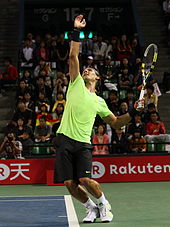
Nadal began his Asian tour at the 2010 PTT Thailand Open in Bangkok where he reached the semifinals, losing to compatriot Guillermo García-López. Nadal was able to regroup, and at the 2010 Rakuten Japan Open Tennis Championships in Tokyo (debut), he defeated Santiago Giraldo,Milos Raonic, and Dmitry Tursunov. In the semifinals against Viktor Troicki, Nadal saved two match points in the deciding set tiebreaker to win it 9–7 in the end. In the final, Nadal comfortably defeated Gaël Monfils for his seventh title of the season.
Nadal next played in the 2010 Shanghai Rolex Masters in Shanghai, where he was the top seed, but lost to world No. 12 Jürgen Melzer in the third round, snapping his record streak of 21 consecutive Masters quarterfinals. On 5 November, Nadal announced that he was pulling out of theParis Masters due to tendinitis in his left shoulder.[120] On 21 November 2010, in London, Nadal won the Stefan Edberg Sportsmanship Award for the first time.[121]
At the 2010 ATP World Tour Finals in London, Nadal defeated Roddick[122] in the first match, Djokovic in the second match, and Berdych in the third match, to advance to the semifinals for the third time in his career. This was the first time that Nadal achieved three wins in the round-robin stage. In the semifinal, he defeated Murray in a hard-fought match to reach his first final at the tournament. In only their second meeting of the year, Federer beat Nadal in the final. After the match, Nadal stated, "Roger is probably the more complete player of the world. I'm not going to say I lost that match because I was tired." This was a reference to his marathon victory over Murray on Saturday. "I tried my best this afternoon, but Roger was simply better than me."[123]
Nadal ended the 2010 season having won three Grand Slams and three Masters 1000 tournaments, and having regained the No. 1 ranking.
Next up for Nadal was a two-match exhibition against Federer for the Roger Federer Foundation. The first match took place in Zürich on 21 December 2010, and the second in Madrid the next day.
2011: Sixth French Open title
Main article: 2011 Rafael Nadal tennis season
Nadal started 2011, by participating in the Mubadala World Tennis Championship in Abu Dhabi, United Arab Emirates. He defeated Tomáš Berdych to reach his third final in the exhibition tournament. In the final, he won over his main rival Roger Federer.
At the Qatar ExxonMobil Open ATP 250 event in Doha, Qatar, Nadal barely struggled past his first three opponents, Karol Beck, Lukáš Lacko, and Ernests Gulbis, citing fever as the primary reason for his poor performance. He fell in straight sets to a resurgent Nikolay Davydenko in the semifinals.[124] He and countryman López won the doubles title by defeating the Italian duo Daniele Bracciali and Andreas Seppi.[125]
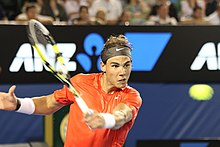
Nadal at the
2011 Australian Open
In the first round of the Australian Open, Nadal defeated Marcos Daniel. In the second round, he beat upcoming qualifier Ryan Sweeting. In the third round, he was tested by emerging player Bernard Tomic of Australia, but Nadal was victorious in straight sets. He went on to defeat Marin Čilić of Croatia, in the fourth round. He suffered an apparent hamstring injury against fellow Spaniard David Ferrer early in the pair's quarterfinal match and ultimately lost in straight sets, thus ending his effort to win four major tournaments in a row.[126]
On 7 February 2011, in Abu Dhabi, United Arab Emirates, Nadal won the Laureus World Sportsman of the Year for the first time, ahead of footballer Lionel Messi, Sebastian Vettel, Spain's Andres Iniesta, Lakers basketball player Kobe Bryant, and Filipino boxer Manny Pacquiao.[127]
In March, Nadal helped Spain defeat Belgium in a 2011 Davis Cup World Group first-round tie on hard indoor courts in the Spiroudome inCharleroi, Belgium. Nadal defeated Ruben Bemelmans.[128] After Spain's victory in three matches, Nadal won a second dead rubber against Olivier Rochus.[129]
At the 2011 BNP Paribas Open in Indian Wells, Nadal defeated upcoming qualifier Rik de Voest in his first match. In the third round, he beat qualifier Ryan Sweeting. He then defeated qualifier Somdev Devvarman in the fourth round. In the quarterfinals, Nadal had a hard time against Croatian Ivo Karlović, and in the semifinals he met Juan Martín del Potro. The last three confrontations between the players were in favor of del Potro, but despite some difficulties, Nadal won in straight sets. He reached his third final at Indian Wells, and lost against Novak Djokovic.[130] The next day, Nadal and Djokovic played a friendly match in Bogotá, Colombia, which Nadal won.[131]
Nadal started the 2011 Sony Ericsson Open with a win over Kei Nishikori then met his compatriot Feliciano López in the third round, whom he defeated. In the fourth round, he defeated Alexandr Dolgopolov. In the quarterfinals, Nadal had the first real test of the tournament when he met the world No. 7 Tomáš Berdych, who he defeated in three sets. In the semifinals, Nadal met his main rival Roger Federer, their first meeting in a semifinal since the 2007 Masters Cup. Nadal won in straight sets. For the second time in two weeks, Nadal faced Novak Djokovic in the final. As in the Indian Wells tournament, Nadal won the first set, and Djokovic the second. The third set ended in a tiebreak, with Djokovic winning.[132] This was the first time Nadal reached the finals of Indian Wells and Miami in the same year.
Nadal began his clay-court season by winning the 2011 Monte-Carlo Rolex Masters with the loss of just one set. Nadal defeated Jarkko Nieminen, Richard Gasquet, Ivan Ljubičić, and Andy Murray to reach his seventh consecutive final in Monte Carlo. In the final, Nadal avenged his defeat by David Ferrer in the quarterfinals of the 2011 Australian Open. He became the first man to win the same tournament seven times in a row at the ATP level in the open era.[133] Nadal chalked up his 37th straight win at the clay-court event, where he has not lost since the 2003 Monte Carlo Masters. It was his 44th career title and 19th at a Masters event.[134] It was his first title since winning the Japan Open. Nadal shares third place with Björn Borg and Manuel Orantes in the list of players with the most titles on clay.[135]
Just a week later, Nadal won his sixth Barcelona Open crown, winning the 2011 Barcelona Open Banco Sabadell final against Ferrer in straight sets. In doing so, Nadal became the first man in the open era to have won two tournaments at least six times each. Nadal was then the leader in terms of matches won in the year, with 29. He did not gain any points for this victory, however, as only four ATP 500 tournaments can be counted towards a players ranking at one time, but they will go into effect 8 August 2011, when the result of the 2010 Legg Mason Tennis Classic expires.[136]
At the 2011 Mutua Madrid Open in May, he defeated Marcos Baghdatis, had a walkover against Juan Martín del Potro, and defeated Michaël Llodra and Roger Federer, before losing the final to Novak Djokovic in two sets.[137]
Nadal again lost in straight sets to Novak Djokovic in the Rome Masters final.[138] This marked the first time that Nadal has lost twice on clay to the same player in a single season.[139] However, Nadal retained his No. 1 ranking during the clay-court season and won his sixth French Open title by defeating Roger Federer.[140]
During the first three rounds of Wimbledon, Nadal beat Michael Russell, Ryan Sweeting, and Gilles Müller. He then faced Juan Martín del Potro in the fourth round and Mardy Fish in the quarterfinals, defeating both players in four sets. His semifinal opponent was world No. 4 Andy Murray. Nadal lost the first set, then won the next three. This set up a final against world No. 2 Novak Djokovic, who had beaten Nadal in all four of their matches in 2011 (all in Masters finals). After dropping the third set, Djokovic defeated Nadal in the fourth. This was the first Grand Slam tournament final that Nadal had lost to someone other than Roger Federer and his first loss at Wimbledon since his five-set loss to Federer in the 2007 final. The loss ended Nadal's winning streak in Grand Slam finals at seven, preventing him from tying the Open-Era record of eight victories in a row set byPete Sampras. Djokovic's success at the tournament also meant that the Serb ascended to world No. 1 for the first time, breaking the dominance of Federer and Nadal on the position, which one of them had held for every week since 2 February 2004. Nadal fell to world No. 2 in the rankings for the first time since June 2010.
After resting for a month from a foot injury sustained during Wimbledon, he contested the 2011 Rogers Cup, where he was shocked by Croatian Ivan Dodig in a third-set tiebreak. He next played in the 2011 Cincinnati Masters, where he lost to Mardy Fish in the quarterfinals.
At the 2011 US Open, Nadal defeated Andrey Golubev in straight sets and advanced to the third round after Frenchman Nicolas Mahut retired. After defeating David Nalbandianon 4 September, Nadal collapsed in his post-match press conference due to severe cramps.[141] Nadal lost to Novak Djokovic in the final in four sets.
After the US Open, Nadal made the final of the Japan Open Tennis Championships. Nadal, who was the 2010 champion, was defeated by Andy Murray. At the Shanghai Masters, Nadal was top seed with the absence of Novak Djokovic, but was upset in the third round by No. 23 ranked Florian Mayer in straight sets. At the 2011 ATP World Tour Finals, Nadal was defeated by Roger Federer in the round-robin stage, in one of the quickest matches between the two, lasting just 60 minutes. In the following match, Nadal was defeated by Jo-Wilfried Tsonga, and was eliminated from the tournament.
In the Davis Cup final in December, Nadal had a quick straight-set win over Juan Mónaco in his first match. In his second match against Juan Martín del Potro, Nadal did not win a single service game in the first set but came back to win the match.[142]
Nadal ended his tennis season with the Mubadala World Tennis Championship, an exhibition tournament not affiliated with the ATP. The tournament, normally held in early January, was held from 29 to 31 December 2011. Nadal had a bye into the semifinals and played against David Ferrer, who defeated Jo-Wilfried Tsonga in the quarterfinals.[143]Ferrer won the match in straight sets.[144] Nadal was then relegated to the third place match against Roger Federer. Nadal won in straight sets.
2012: Seventh French Open title
Main article: 2012 Rafael Nadal tennis season

Nadal during the finals of the Monte-Carlo Rolex Masters
Nadal began his ATP World Tour season at the Qatar Open. He beat Philipp Kohlschreiber and qualifier Denis Gremelmayr in rounds one and two and then won against seventh-seeded Mikhail Youzhny.[145] In the semifinal he lost to Gaël Monfils in two sets.[146]
In the Australian Open Nadal began the tournament by breezing past qualifier Alex Kuznetsov of United States.[147] The second round against Tommy Haas, who has never won a set against Rafael, was tighter, but Nadal again advanced in three straight sets.[148] He defeated Feliciano López in the fourth round, then won in his quarterfinal and semifinal matches against Tomáš Berdych and Roger Federer respectively. By doing so, he has reached the finals of all four majors consecutively. In the final, on 29 January, he was beaten by Novak Djokovic in a five-set match that lasted 5 hours and 53 minutes, the longest ever match for a Grand Slam title. The pair set a new world record, breaking the latest longest major singles final between Mats Wilander and Ivan Lendl, which lasted 4 hours and 54 minutes, at the US Open in 1988.[149]
Nadal made it to the semifinals in Indian Wells, where he was beaten in straight sets by eventual champion Roger Federer. He also made the semifinals in Miami, but withdrew because of knee problems.
As the clay court season started, Nadal was seeded 2nd at the 2012 Monte-Carlo Rolex Masters. He defeated Jarkko Nieminen, Mikhael Kukushkin, Stanislas Wawrinka, andGilles Simon before topping world No. 1 Novak Djokovic to win his 8th consecutive Monte Carlo trophy. This ended a streak of seven straight final losses to Djokovic, which began at the 2011 Indian Wells Masters final.
A day after the Monte Carlo Masters Final, Nadal traveled to Barcelona where he received a bye in the first round. His tremendous record on clay continued as he beat compatriot David Ferrer in a hard fought final to clinch his seventh title in eight years at the Barcelona Open.
The Mutua Madrileña Madrid Open did not go very well for Nadal. He beat Nikolay Davydenko, one of the few players to hold a positive head to head record over Nadal, in straight sets. He then lost to Fernando Verdasco, who he held a 13–0 record against in the third round 7–5 in the third, after blowing a 4–0 final set lead. Nadal stated that he was very unhappy with the new blue-colored clay and threatened not to attend in the future if the surface was not changed back to red clay. Several other players (such as Novak Djokovic) voiced similar criticism.[150]
In the last tournament before the French Open, Nadal went to the Internazionali BNL d'Italia in Rome. He advanced to his 7th final after defeating Florian Mayer, Marcel Granollers, Tomáš Berdych, and David Ferrer all in straight sets, setting up another finals showdown with World number one Novak Djokovic. Nadal defeated Djokovic in a tight straight sets encounter. This was his second victory over Novak Djokovic in 2012 and his third title of the season, as well as his 6th Rome title overall.
At the 2012 French Open, Nadal dropped only 30 games against his first five opponents, without losing a set. In the semifinal he faced a friend and compatriot in David Ferrer. Unlike their previous two encounters in Barcelona and Rome, Nadal showed almost no flaws, dismantling Ferrer to set up another championship title fight with world No. 1 Novak Djokovic. This marked the first time where two opposing players faced each other in four consecutive Grand Slam tournament finals. They also became the only players to have faced the same opponent in the finals of all four Majors. Nadal won the first two sets before Djokovic claimed the third. Play was suspended in the fourth set due to rain. When the match resumed the following day, Nadal won when Djokovic double faulted on match point, sealing a record 7th Roland Garros title for Nadal.[151] Throughout the tournament, Nadal lost only one set, occurring in the final. By winning his seventh title[152] at Roland Garros, Nadal surpassed Borg's overall titles record[153] to become the most successful tennis player in French Open history.[154] Nadal only lost a total of three sets in the 2012 clay court season.
In his first grass court tournament of the season at Halle, Nadal advanced to quarterfinals, where he lost to Philipp Kohlschreiber.[155] At Wimbledon, Nadal beat Thomaz Bellucciin the first round. He then met Lukáš Rosol in the second round, a player who was then ranked 100th in the world and had never advanced beyond the first qualifying round in his five previous Wimbledons. In one of the biggest upsets in Grand Slam history, Rosol defeated Nadal in five sets. This was the first time since the Wimbledon 2005 championships that Nadal had failed to progress past the 2nd round of a Grand Slam tournament.[156]
In July 2012, Nadal withdrew from the 2012 Olympics due to tendinitis in his knee, which subsequently also led to him pulling out of both the Rogers Cup and Cincinnati Masters. On 15 August, Nadal announced his withdrawal from the US Open in New York, as he felt he still was not healthy enough to compete.[157][158] On 11 September 2012, Nadal fell to a world No. 4 ranking, his lowest since 2010, as 2012 US Open winner Andy Murray climbed to No. 3.[159] Nadal ended 2012 ranked No. 4 in the world, the first time in eight years that he has not been ranked 1st or 2nd at the end of the year.
2013: Eighth French Open, second US Open title and return to No. 1
Main article: 2013 Rafael Nadal tennis season
Two weeks prior to the 2013 Australian Open, Nadal officially withdrew from the tournament citing a stomach virus.[160] Nadal's withdrawal subsequently saw him drop out of the ATP's Top Four for the first time since 2005.[161]
Playing in his first tournaments in South America since 2005, Nadal made his comeback at the Latin American Golden Swing, starting his 2013 season at the 2013 VTR Open in Chile,[162] where he advanced to the final without dropping a set but was beaten by Argentine world No. 73 journeyman Horacio Zeballos. He also lost in the doubles final (with Juan Mónaco). At the 2013 Brasil Open, at São Paulo, Nadal struggled in the opening rounds, dropping sets to Berlocq and qualifier Alund. Despite the poor clay surface, which was the subject of player complaints, he reached the final, where he defeated David Nalbandian.[163] In the title match of the 2013 Abierto Mexicano Telcel in Acapulco, Nadal defeated world No. 4 David Ferrer, losing just two games in the match.
Nadal then returned to the American hard courts after a year, playing the Indian Wells Masters as the fifth seed. He lost only one set, and defeated world No. 2 Roger Federerand world No. 6 Tomáš Berdych in the matches leading up to the final. Nadal recovered from being one set down in the final, to defeat Juan Martín del Potro. This was his third Indian Wells Masters title and his first hardcourt title since October 2010, and made Nadal the player with the most Masters 1000s wins.
After withdrawing from Miami, Nadal attempted to defend his title at the 2013 Monte-Carlo Rolex Masters, but, despite reaching the final for the ninth consecutive year, he was beaten by Djokovic in straight sets. He then won at the 2013 Barcelona Open Banco Sabadell over Almagro, in straight sets. This was his 8th victory there, making him the first man to win two different tournaments eight or more times each. It was also his fourth title of the season, and his sixth consecutive final.
Nadal won his 23rd ATP Masters 1000 tournament at the 2013 Mutua Madrid Open, beating Wawrinka, despite previously having been two points from defeat in his quarterfinal against David Ferrer. The blue clay that had troubled him the previous year there had been exchanged for the traditional red clay. In May, he won his record 24th Masters 1000 title, beating Roger Federer for his 7th championship at the 2013 Rome Masters. It was his 6th title of the season and his eighth consecutive final. These victories raised his ranking to world No. 4.
Nadal won the 2013 French Open after beating Djokovic in the semifinal and Ferrer in the final. His match with Djokovic was widely considered one of the greatest clay court matches ever played, as Nadal came back from down a break in the fifth set to take out a hard-fought 4-hour, 37-minute victory. However, because of the nuances of how rankings are calculated (including an improvement in performance by the then world No. 5 David Ferrer at the French Open), Nadal's world ranking dropped from No. 4 to No. 5, with Ferrer replacing him at No. 4.
Nadal then lost his first-round match at the 2013 Wimbledon Championships in straight sets to unseeded Belgian Steve Darcis (ranked No. 135), making it the second time in a row he failed to reach the third round at Wimbledon and the first ever time Nadal had lost in the first round of a Grand Slam. Darcis is the lowest-ranked player ever to beat Nadal in a Grand Slam tournament.
In August 2013, Nadal won the semifinal match in Montreal, denying Djokovic his fourth Rogers Cup title.[164] Nadal proceeded to win the title after beating Milos Raonic in the final in straight sets. This was Nadal's 25th Masters 1000 title and third title at the Canadian Open.[165] He won his 26th ATP Masters 1000 in Cincinnati on Sunday 18 August after beating John Isner in the final.[27] Nadal concluded a brilliant North American hard court season with his 4th hard court title of the year, defeating Djokovic at the 2013 US Open final in four sets, bringing his Slam count to 13 and giving Nadal a male tennis record paycheck of $3.6 million.[166][167]
Later in September, Nadal helped Spain secure their Davis Cup World Group Playoff spot for 2014, with a victory against Sergiy Stakhovsky and a doubles win with Marc Lopez. In October, he reached the final of the China Open, guaranteeing he would become world number one for the third time after losing it in July 2011.[168] In the final, he was beaten by Djokovic in straight sets.[169] At the 2013 Shanghai Rolex Masters, Nadal reached the semi-finals but was defeated by Del Potro.
In November 2013, Nadal played his final event of the season in London at the 2013 ATP World Tour Finals where he secured the year end World Number One spot. Nadal beat David Ferrer, Stanislas Wawrinka and Tomáš Berdych in the Round Robin stage to set up a semi final and victory over Roger Federer. Nadal met Djokovic in the final, losing in straight sets.
2014: Ninth French Open title and struggle with injury
Main article: 2014 Rafael Nadal tennis season

Nadal during a press conference at the
2014 Internazionali BNL d'Italia
Rafael Nadal began his 2014 season at the Qatar Open in Doha, defeating Lukáš Rosol in the first round[170] and he won the title after defeating Gaël Monfils in the final.[171] It was announced in February 2014 that "After compiling one of the greatest comeback seasons on the ATP World Tour in 2013, World No. 1 Rafael Nadal is a contender to be nominated for the Laureus World Comeback of the Year Award."[172]
At the Australian Open, he defeated Roger Federer to reach his third Australian Open final, improving his career record against Federer to 23–10. This marked Nadal's 11th consecutive victory in a Major semifinal (second only to Borg's all-time record of 14), and advanced him to his 19th Major final, tying him with Lendl for second all-time behind Federer's 24. It also marked Nadal's sixth consecutive victory over Federer in a Major. In the final, he faced Stanislas Wawrinka, against whom he entered the match with a 12-0 record, having won all of their previous 26 sets. After losing the first set, Nadal suffered a back injury down 2-0 in the second set, and although he won a set, he lost the match in four sets. The first tournament he played after that was the inaugural Rio Open which he won after defeating Alexandr Dolgopolov in the final extending his record of ATP 500 titles to 15. However, at the Indian Wells Masters, Dolgopolov would avenge his loss, defeating Nadal in three sets in the third round. He reached the final of the Miami Masters before falling to Novak Djokovic in straight sets.
Nadal began his clay court season with a quarterfinal loss to David Ferrer in the Monte-Carlo Masters. He was stunned by Nicolas Almagro in the quarterfinals of the Barcelona Open. Nadal won the Madrid Open after Kei Nishikori retired in the third set.[29] On 8 June 2014, Nadal defeated Novak Djokovic in the Men's Singles French Open final to win his 9th French Open title and a 5th straight win at Roland Garros. Nadal dropped the first set but came back in the game to win the next three sets to lift the trophy. Nadal equaled Pete Sampras' total of 14 Grand Slam wins, the second highest number of single Grand Slam titles after Roger Federer.[173] Nadal lost in the second round of the Halle Open toDustin Brown the following week.[174]
Nadal then entered the Wimbledon Championships in a bid to win the tournament for the third time and to win his 15th Grand Slam title overall. In the first three rounds he facedMartin Kližan, Lukáš Rosol (to whom he suffered a shock defeat at the same stage of the tournament two years earlier) and Mikhail Kukushkin. In each of these matches he lost the first set before taking command and winning them in four sets. In the fourth round he faced Australian teenager Nick Kyrgios (ranked 143 places lower than Nadal) and again lost the first set, but despite winning the second set, he was unable to turn the tide and eventually lost in four sets.[175]
Nadal withdrew from the American swing due to a wrist injury.[176] He made his return at the 2014 China Open but was defeated in the quarterfinals by Martin Klizan in three sets.[177] At the 2014 Shanghai Rolex Masters, he suffered from appendicitis, therefore he eventually went down by Feliciano Lopez in straight sets.[178] Later, he was upset byBorna Ćorić at the quarterfinals of the 2014 Swiss Indoors. After the loss, he announced that he would skip the rest of the season to undergo surgery for his appendix.[179]
2015: Continued struggle with form and fall in rankings
Main article: 2015 Rafael Nadal tennis season
Nadal began the year as the defending Champion at Qatar, but suffered a shocking three set defeat to Michael Berrer in round one of the Qatar Open.[180] He won the doubles title with Juan Monaco. At the Australian Open, Nadal beat Mikhail Youzhny in the first round in straight sets, before prevailing in a tough five-setter against American Tim Smyczek in the second round, despite being visibly unwell at times during the game.[citation needed] He then beat Dudi Sela and Kevin Anderson in straight sets to advance to his 28th career quarterfinal. Nadal lost in straight sets to Tomáš Berdych in the quarterfinal, thus ending a 17-match winning streak against the seventh-seeded Czech.[181]

Nadal at the 2015
Aegon Championships in London
Nadal lost in the semifinals to Fabio Fognini at the Rio Open,[182] before going on to win his 46th career clay-court title against Juan Monaco at the Argentina Open.[183] Nadal then participated at the Indian Wells and Miami Open but suffered early defeats to Milos Raonicand Fernando Verdasco, in the quarterfinals and third round respectively.[184][185] Nadal then began his summer clay season at the Monte Carlo Masters and reached the semifinals where he lost to Novak Djokovic in straight sets.[186] After losing to Fognini again at theBarcelona Open quarterfinals,[187] Nadal entered the Madrid Open as the two-time defending champion but lost in the final to Andy Murray in straight sets, resulting in him dropping out of the top five for the first time since 2005.[188][189] He then lost in the quarterfinals of theRome Masters to Stan Wawrinka in straight sets.[190]
Nadal lost to Djokovic in the quarterfinals of the French Open, ending his winning streak of 39 consecutive victories in Paris since his defeat by Robin Söderling in 2009.[191] Nadal went on to win the 2015 Mercedes Cup against Serbian Viktor Troicki, his first grass court title since he won at Wimbledon in 2010.[192] He was unable to continue his good form on grass as he lost in the first round of the Aegon Championships to Alexandr Dolgopolov in three sets.[193] Nadal's struggles continued when he lost in the second round of Wimbledon toDustin Brown.[194]
Rivalries
See also: Big Four (tennis)
Nadal vs. Federer
Main article: Federer–Nadal rivalry
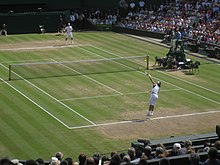
Nadal and Federer during the
2006 Wimbledon Championships final
Federer and Nadal have been playing each other since 2004, and their rivalry is a significant part of both men's careers.[64][195][196] They held the top two rankings on the ATP Tour from July 2005 until 14 August 2009, when Nadal fell to world No. 3 (Andy Murray became the new No. 2).[197] They are the only pair of men to have ever finished four consecutive calendar years at the top.[198][199] Nadal ascended to No. 2 in July 2005 and held this spot for a record 160 consecutive weeks before surpassing Federer in August 2008.[200]
They have played 33 times, and Nadal leads their head-to-head series 23–10 overall and 9–2 in Grand Slam tournaments. Federer has a winning record on grass (2–1) and indoor hard courts (4–1) while Nadal leads the outdoor hard courts by 8–2 and clay by 13–2.[201]
As tournament seedings are based on rankings, 20 of their matches have been in tournament finals, including an all-time record eight Grand Slam tournament finals.[202] From 2006 to 2008, they played in every French Open and Wimbledon final, and also met in the title match of the 2009 Australian Open and the 2011 French Open.[202] Nadal won six of the eight, losing the first two Wimbledon finals. Three of these matches were five set-matches (2007 and 2008 Wimbledon, 2009 Australian Open), and the 2008 Wimbledon final has been lauded as the greatest match ever by many long-time tennis analysts.[65][203][204][205] Nadal is the only player who has competed and won against Federer in the final of a Major on all three surfaces (grass, hard and clay), while losing to Federer only on grass.[citation needed]
Nadal vs. Djokovic
Main article: Djokovic–Nadal rivalry
Novak Djokovic and Nadal have met 44 times (more than any other players in the Open Era) with Nadal having a 23–21 advantage.[164][206][207] Nadal leads on grass 2–1 and clay 14–6, but Djokovic leads on hard courts 14–7.[164][207] In 2009, this rivalry was listed as the third greatest of the previous 10 years by ATPworldtour.com.[208] Djokovic is one of only two players to have at least ten match wins against Nadal (the other being Federer) and the only person to defeat Nadal seven consecutive times and two times consecutively on clay. The two earlier shared the record for the longest match played in a best of three sets (4 hours and 3 minutes) at the 2009 Mutua Madrid Open semifinals until the match between Roger Federer and Juan Martín del Potro in the London 2012 Olympics Semifinal, which is the longest best-of-three-set match by time (at 4 hours and 26 minutes).[209][210] They have also played in a record 12 Masters Series finals.
In the 2011 Wimbledon final, Djokovic won in four sets for his first Slam final over Nadal.[211] Djokovic also defeated Nadal in the 2011 US Open Final. In 2012, Djokovic defeated Nadal in the Australian Open final for a third consecutive Slam final win over Nadal. This was the longest Grand Slam tournament final in Open era history at 5 hrs, 53 mins.[212]Nadal won their last three 2012 meetings in the final of Monte Carlo Masters, Rome Masters and French Open in April, in May and in June 2012, respectively.[213] In 2013, Djokovic defeated Nadal in straight sets in the final at Monte Carlo, ending Nadal's record eight consecutive titles there, but Nadal got revenge at the French Open in an epic five-setter 9–7 in the fifth. In August 2013, Nadal won in Montreal, denying Djokovic his fourth Rogers Cup title.[164] Nadal also defeated Djokovic in the 2013 US Open Final. In their third clash of 2014 Nadal defeated Djokovic in the 2014 French Open final.
Nadal vs. Murray
Main article: Murray–Nadal rivalry

Nadal and Murray in Tokyo
Nadal and Andy Murray have met on 21 occasions since 2007, with Nadal leading 15–6. Nadal leads 6–1 on clay, 3–0 on grass and 6–5 on hard courts (including 5–3 in outdoor courts, but Murray leads 2–1 on indoor hard courts). The pair once met regularly at Grand Slamlevel, with eight out of their twenty-one meetings coming in slams, with Nadal leading 6–2 (3–0 at Wimbledon, 1–0 at the French Open, 1–1 at the Australian Open & 1–1 at the US Open).[214] Seven of these eight appearances have been at quarterfinal and semifinal level, making the rivalry an important part of both men's careers. They have never met in a Slam final, however, Murray leads 3–1 in ATP finals, with Nadal winning at Indian Wells in 2009[215] and Murray winning in Rotterdam the same year,[216] Tokyo[217] in 2011, and Madrid in2015.
Murray lost three consecutive Grand Slam semifinals to Nadal in 2011 from the French Open to the US Open. Remarkably, of the past 19 Grand Slam drawsheets, they have been drawn in the same half 16 times. The pair did not meet in 2012, having been scheduled to meet in the semifinal of the Miami Masters before Nadal withdrew with injury.[218]
Playing style
Nadal generally plays an aggressive, behind-the-baseline game founded on heavy topspin groundstrokes, consistency, speedy footwork and tenacious court coverage, thus making him an aggressive counterpuncher.[219] Known for his athleticism and speed around the court, Nadal is an excellent defender[220] who hits well on the run, constructing winning plays from seemingly defensive positions. He also plays very fine dropshots, which work especially well because his heavy topspin often forces opponents to the back of the court.[221]
Nadal employs a semi-western grip forehand, often with a "lasso-whip" follow through, where his left arm hits through the ball and finishes above his left shoulder – as opposed to a more traditional finish across the body or around his opposite shoulder.[222][223] Nadal's forehand groundstroke form allows him to hit shots with heavy topspin – more so than many of his contemporaries.[224]
San Francisco tennis researcher John Yandell used a high-speed video camera and special software to count the average number of revolutions of a tennis ball hit full force by Nadal. While Nadal's shots tend to land short of the baseline, the characteristically high bounces his forehands achieve tend to mitigate the advantage an opponent would normally gain from capitalizing on a short ball.[225] Although his forehand is based on heavy topspin, he can hit the ball deep and flat with a more orthodox follow through for clean winners.
| “ | "The first guys we did were Sampras and Agassi. They were hitting forehands that in general were spinning about 1,800 to 1,900 revolutions per minute. Federer is hitting with an amazing amount of spin, too, right? 2,700 revolutions per minute. Well, we measured one forehand Nadal hit at 4,900. His average was 3,200." | ” |
—John Yandell, San Francisco-based tennis researcher.[226]
|
Nadal's serve was initially considered a weak point in his game, although his improvements in both first-serve points won and break points saved since 2005 have allowed him to consistently compete for and win major titles on faster surfaces. Nadal relies on the consistency of his serve to gain a strategic advantage in points, rather than going for service winners.[227]However, before the 2010 US Open, he altered his service motion, arriving in the trophy pose earlier and pulling the racket lower during the trophy pose. Before the 2010 U.S. Open, Nadal modified his service grip to a more continental one. These two changes in his serve increased his average speed by around 10 mph during the 2010 US Open, maxing out at 135 mph (217 km), allowing him to win more free points on his serve.[228] However, since the 2010 US Open, Nadal's serve speed has dropped back down to previous levels and has again been cited as a need for improvement.[229][230][231]
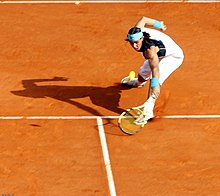
Nadal is a clay court specialist in the sense that he has been extremely successful on that surface. Since 2005, he won nine times at Roland Garros, eight times at Monte Carlo and seven at Rome. However, Nadal has shed that label due to his success on other surfaces, including holding simultaneous Grand Slam tournament titles on grass, hard courts, and clay on two separate occasions, winning eight Masters series titles on hardcourt, and winning the Olympic gold medal on hardcourt.[219][232]
Despite praise for Nadal's talent and skill, some have questioned his longevity in the sport, citing his build and playing style as conducive to injury.[233] Nadal himself has admitted to the physical toll hard courts place on ATP Tour players, calling for a reevaluated tour schedule featuring fewer hard court tournaments.[234]
Public image
Equipment and endorsements
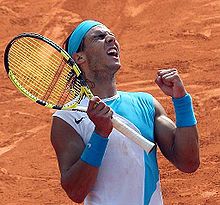
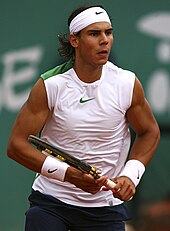
Nike sleeveless shirt with matching headband & wrist bands and
BabolatAeroPro Drive GT at
Roland Garros2007
Nadal has been sponsored by Kia Motors since 2006. He has appeared in advertising campaigns for Kia as a global ambassador for the company. In May 2008, Kia released a claymation viral ad featuring Nadal in a tennis match with an alien.[235] In May 2015, Nadal extended his partnership with Kia for another five years.[236]
Nike serves as Nadal's clothing and shoe sponsor. Nadal's signature on-court attire entailed a variety of sleeveless shirts paired with 3/4 length capri pants.[237] For the 2009 season, Nadal adopted more-traditional on-court apparel. Nike encouraged Nadal to update his look in order to reflect his new status as the sport's top player at that time[238] and associate Nadal with a style that, while less distinctive than his "pirate" look, would be more widely emulated by consumers.[239][240] At warmup tournaments in Abu Dhabi and Doha, Nadal played matches in a polo shirt specifically designed for him by Nike,[241] paired with shorts cut above the knee. Nadal's new, more conventional style carried over to the 2009 Australian Open, where he was outfitted with Nike's Bold Crew Men's Tee[242] and Nadal Long Check Shorts.[243][244][245] Nadal wears Nike's Air CourtBallistec 2.3 tennis shoes,[246] bearing various customizations throughout the season, including his nickname "Rafa" on the right shoe and a stylized bull logo on the left.
He became the face of Lanvin's L'Homme Sport cologne in April 2009.[247] Nadal uses an AeroPro Drive racquet with a 41⁄4-inch L2 grip. As of the 2010 season, Nadal's racquets are painted to resemble the new Babolat AeroPro Drive with Cortex GT racquet in order to market a current model which Babolat sells.[248][249] Nadal uses no replacement grip, and instead wraps two overgrips around the handle. He used Duralast 15L strings until the 2010 season, when he switched to Babolat's new, black-colored, RPM Blast string. Nadal's rackets are always strung at 55 lb (25 kg), regardless of which surface or conditions he is playing on.[citation needed]
As of January 2010, Nadal is the international ambassador for Quely, a company from his native Mallorca that manufactures biscuits, bakery and chocolate coated products; he has consumed their products ever since he was a young child.[250]
In 2010, luxury watchmaker Richard Mille announced that he had developed an ultra-light wristwatch in collaboration with Nadal called the Richard Mille RM027 Tourbillon watch.[251] The watch is made of titanium and lithium and is valued at US$525,000; Nadal was involved in the design and testing of the watch on the tennis court.[251] During the 2010 French Open, Men's Fitness reported that Nadal wore the Richard Mille watch on the court as part of a sponsorship deal with the Swiss watchmaker.[252]
Nadal replaced Cristiano Ronaldo as the new face of Emporio Armani Underwear and Armani Jeans for the spring/summer 2011 collection.[253] This was the first time that the label has chosen a tennis player for the job; association football has ruled lately prior to Ronaldo, David Beckham graced the ads since 2008.[254] Armani said that he selected Nadal as his latest male underwear model because "...he is ideal as he represents a healthy and positive model for youngsters."[253]
In June 2012, Nadal joined the group of sports endorsers of the PokerStars online poker cardroom.[255] In December 2013, Nadal won a charity poker tournament against retired Brazilian football player Ronaldo and four other competitors.[256]
In popular culture
In February 2010, Rafael Nadal was featured in the music video of Shakira's "Gypsy".[257][258] and part of her album release She Wolf. In explaining why she chose Nadal for the video, Shakira was quoted as saying in an interview with the Latin American Herald Tribune: "I thought that maybe I needed someone I could in some way identify with. And Rafael Nadal is a person who has been totally committed to his career since he was very young. Since he was 17, I believe."[259][260]
Asteroid
128036 Rafaelnadal is a main belt asteroid discovered in 2003 at the Observatorio Astronómico de Mallorca and named after Nadal.[261]
Off the court
Nadal is an avid fan of association football club Real Madrid. On 8 July 2010, it was reported that he had become a shareholder of RCD Mallorca, his local club by birth, in an attempt to assist the club from debt.[262] Nadal reportedly owns 10 percent and was offered the role of vice president, but he rejected that offer.[263] His uncle Miguel Ángel Nadal, became assistant coach under Michael Laudrup. Nadal remains a passionate Real Madrid supporter; ESPN.com writer Graham Hunter wrote, "He's as Merengue as [Real Madrid icons] Raúl, Iker Casillas and Alfredo Di Stéfano."
Shortly after acquiring his interest in Mallorca, Nadal called out UEFA for apparent hypocrisy in ejecting the club from the 2010–11 UEFA Europa League for excessive debts, saying through a club spokesperson, "Well, if those are the criteria upon which UEFA is operating, then European competition will only comprise two or three clubs because all the rest are in debt, too."
He is a fervent supporter of the Spanish national team, one of only six people not affiliated with the team or the national federation allowed into the team's locker room immediately following Spain's victory in the 2010 FIFA World Cup Final.
Philanthropy
Nadal took part in Thailand's "A Million Trees for the King" project, planting a tree in honour of King Bhumibol Adulyadej on a visit to Hua Hin during his Thailand Open 2010. "For me it's an honour to part of this project", said Nadal. "It's a very good project. I want to congratulate the Thai people and congratulate the King for this unbelievable day. I wish all the best for this idea. It's very, very nice."[265]
Fundación Rafa Nadal
The creation of the Fundación Rafa Nadal took place in November 2007, and its official presentation was in February 2008, at the Manacor Tennis Club in Mallorca, Spain. The foundation will focus on social work and development aid particularly on childhood and youth.[266] On deciding why to start a foundation, Nadal said "This can be the beginning of my future, when I retire and have more time, [...] I am doing very well and I owe society, [...] A month-and-a-half ago I was in Chennai, in India. The truth is we live great here....I can contribute something with my image..." Nadal was inspired by the Red Cross benefit match against malaria with Real Madrid goalkeeper Iker Casillas, recalling, "We raised an amount of money that we would never have imagined. I have to thank Iker, my project partner, who went all out for it, [...] That is why the time has come to set up my own foundation and determine the destination of the money."
Nadal's mother, Ana Maria Parera, chairs the charitable organization and father Sebastian is vice-chairman. Coach and uncle Toni Nadal and his agent, former tennis playerCarlos Costa, are also involved. Roger Federer has given Nadal advice on getting involved in philanthropy. Despite the fact that poverty in India struck him particularly hard, Nadal wants to start by helping "people close by, in the Balearic Islands, in Spain, and then, if possible, abroad."[267]
On 16 October 2010, Nadal traveled to India for the first time to visit his tennis academy for underprivileged children at Anantapur Sports Village, in the Anantapur City, Andhra Pradesh. His foundation has also worked in the Anantapur Educational Center project, in collaboration with the Vicente Ferrer Foundation.[268][269]
Personal life
Nadal lived with his parents and younger sister Maria Isabel in a five-story apartment building in their hometown of Manacor, Mallorca. In June 2009, Spanish newspaper La Vanguardia, and then The New York Times, reported that his parents, Ana Maria and Sebastian, had separated. This news came after weeks of speculation in Internet posts and message boards over Nadal's personal issues as the cause of his setback.[270]
Nadal has revealed himself to be agnostic.[271] As a young boy, he would run home from school to watch Goku in his favorite Japanese anime, Dragon Ball. CNN released an article about Nadal's childhood inspiration, and called him "the Dragon Ball of tennis" due to his unorthodox style "from another planet."[272]
In addition to tennis and football, Nadal enjoys golf and also poker.[273] In April 2014 he played the world's number 1 female poker player, Vanessa Selbst, in a poker game in Monaco.[274] Nadal's autobiography, Rafa (Hyperion, 2012, ISBN 1401310923), written with assistance from John Carlin, was published in August 2011.[275]
Career statistics
Main article: Rafael Nadal career statistics
Grand Slam tournament performance timeline
To prevent confusion and double counting, information in this table is updated only once a tournament or the player's participation in the tournament has concluded. This table is current through the 2015 French Open.
| Tournament | 2003 | 2004 | 2005 | 2006 | 2007 | 2008 | 2009 | 2010 | 2011 | 2012 | 2013 | 2014 | 2015 | SR | W–L | Win % |
|---|
| Australian Open | A | 3R | 4R | A | QF | SF | W | QF | QF | F | A | F | QF | 1 / 10 | 45–9 | 83.33 |
| French Open | A | A | W | W | W | W | 4R | W | W | W | W | W | QF | 9 / 11 | 70–2 | 97.22 |
| Wimbledon | 3R | A | 2R | F | F | W | A | W | F | 2R | 1R | 4R | 2R | 2 / 11 | 40–9 | 81.63 |
| US Open | 2R | 2R | 3R | QF | 4R | SF | SF | W | F | A | W | A | | 2 / 10 | 41–8 | 83.67 |
| Win–Loss | 3–2 | 3–2 | 13–3 | 17–2 | 20–3 | 24–2 | 15–2 | 25–1 | 23–3 | 14–2 | 14–1 | 16–2 | 9–3 | 14 / 42 | 196–28 | 87.5 |
|---|
- Finals: 20 (14 titles, 6 runners-up)
| Score |
|---|
| Winner | 2005 | French Open | Clay |  Mariano Puerta Mariano Puerta | 6–7(6–8), 6–3, 6–1, 7–5 |
| Winner | 2006 | French Open (2) | Clay |  Roger Federer Roger Federer | 1–6, 6–1, 6–4, 7–6(7–4) |
| Runner-up | 2006 | Wimbledon | Grass | Roger Federer | 0–6, 6–7(5–7), 7–6(7–2), 3–6 |
| Winner | 2007 | French Open (3) | Clay | Roger Federer | 6–3, 4–6, 6–3, 6–4 |
| Runner-up | 2007 | Wimbledon (2) | Grass | Roger Federer | 6–7(7–9), 6–4, 6–7(3–7), 6–2, 2–6 |
| Winner | 2008 | French Open (4) | Clay | Roger Federer | 6–1, 6–3, 6–0 |
| Winner | 2008 | Wimbledon | Grass | Roger Federer | 6–4, 6–4, 6–7(5–7), 6–7(8–10), 9–7 |
| Winner | 2009 | Australian Open | Hard | Roger Federer | 7–5, 3–6, 7–6(7–3), 3–6, 6–2 |
| Winner | 2010 | French Open (5) | Clay |  Robin Söderling Robin Söderling | 6–4, 6–2, 6–4 |
| Winner | 2010 | Wimbledon (2) | Grass |  Tomáš Berdych Tomáš Berdych | 6–3, 7–5, 6–4 |
| Winner | 2010 | US Open | Hard |  Novak Djokovic Novak Djokovic | 6–4, 5–7, 6–4, 6–2 |
| Winner | 2011 | French Open (6) | Clay | Roger Federer | 7–5, 7–6(7–3), 5–7, 6–1 |
| Runner-up | 2011 | Wimbledon (3) | Grass | Novak Djokovic | 4–6, 1–6, 6–1, 3–6 |
| Runner-up | 2011 | US Open | Hard | Novak Djokovic | 2–6, 4–6, 7–6(7–3), 1–6 |
| Runner-up | 2012 | Australian Open | Hard | Novak Djokovic | 7–5, 4–6, 2–6, 7–6(7–5), 5–7 |
| Winner | 2012 | French Open (7) | Clay | Novak Djokovic | 6–4, 6–3, 2–6, 7–5 |
| Winner | 2013 | French Open (8) | Clay | David Ferrer | 6–3, 6–2, 6–3 |
| Winner | 2013 | US Open (2) | Hard | Novak Djokovic | 6–2, 3–6, 6–4, 6–1 |
| Runner-up | 2014 | Australian Open (2) | Hard | Stan Wawrinka | 3–6, 2–6, 6–3, 3–6 |
| Winner | 2014 | French Open (9) | Clay | Novak Djokovic | 3–6, 7–5, 6–2, 6–4 |
Year-end Championship performance timeline
| Tournament | 2002 | 2003 | 2004 | 2005 | 2006 | 2007 | 2008 | 2009 | 2010 | 2011 | 2012 | 2013 | 2014 | SR | W–L | Win % |
|---|
| Year-End Championship Tournaments |
| YEC | DNQ | DNQ | DNQ | A | SF | SF | A | RR | F | RR | A | F | A | 0 / 6 | 13–11 | 54.17 |
|---|
- Finals: 2 (2 runners-up)
|
| Runner-up | 2010 | ATP World Tour Finals | Hard (i) | Roger Federer | 3–6, 6–3, 1–6 |
| Runner-up | 2013 | ATP World Tour Finals (2) | Hard (i) | Novak Djokovic | 3–6, 4–6 |
Olympic Games
- Finals: 1 (1 gold medal)
|
| Winner | 2008 | Beijing Olympics | Hard |  Fernando González Fernando González | 6–3, 7–6(7–2), 6–3 |
Records
Main article: List of career achievements by Rafael Nadal
All-time tournament records
| Tournament | Since | Record accomplished | Players matched |
|---|
| All | 1877 | 8 consecutive titles at any single tournament | Stands alone |
| Grand Slam | 1877 | 9 men's singles titles at any single Grand Slam event | Stands alone |
| Monte Carlo Masters | 1897 | 8 men's singles titles | Stands alone |
| French Open | 1925 | 9 men's singles titles | Stands alone |
| Rome Masters | 1930 | 7 men's singles titles | Stands alone |
| Barcelona Open | 1953 | 8 men's singles titles | Stands alone |
Open Era records
- These records were attained in the Open Era of tennis.
- Records in bold indicate peer-less achievements.
- Records in italics are currently active streaks.
- ^ Denotes consecutive streak.
| [show]Time span | Selected Grand Slam tournament records | Players matched | Refs |
|---|
| [show]Grand Slam tournaments | Time Span | Records at each Grand Slam tournament | Players matched | Refs |
|---|
| [show]Time span | Other selected records | Players matched | Refs |
|---|
See also
 | Tennis portal |
- ATP World Tour Awards
- Tennis records of the Open Era – Men's Singles
- Tennis records of All Time - Men's Singles
- ATP World Tour records
- List of ATP number 1 ranked players
- List of Grand Slam men's singles champions
- List of Grand Slam related tennis records
- List of non-Grand Slam tennis statistics and records
- List of open era tennis records
Notes
- Jump up^ See[4][5][6][7][8]
- Jump up^ See[9][10][11][12][13][14]
- Jump up^ See[15][16][17][18][19][20][21][22]
- Jump up^ The finals Nadal reached without losing a set were the 2007,[280] 2008, 2010 & 2012French Open and the 2010 US Open.[281]
- ^ Jump up to:a b The term "combined Championship Masters Series" encompasses the Grand Prix Championship Series (1970–1989), ATP Masters Series (1990–2008) and ATP World Tour Masters 1000 (2009–present).
- Jump up^ The "Clay Slam" consists of winning the Monte Carlo Masters, Rome Masters, Madrid Masters and French Open in the same year.[295]
- Jump up^ The world No. 1 players who Nadal defeated were Roger Federer (13 times)[299] andNovak Djokovic (6 times).[300]
- Jump up^ Career match winning percentage overall encompasses all surfaces.